Accrued payroll refers to wages and related expenses incurred by a business that have yet to be paid to employees.
According to IRS rules, businesses that follow the Generally Accepted Accounting Principles (GAAP) in recording and reporting their finances are required to use accrual-basis accounting, as are businesses making an average of $25 million or more in sales for the preceding three years.
Want to know more about it? You’re in the right place.
Below, we discuss the different types of payroll accrual, how to calculate them, and the benefits they provide for your organization’s financial health.
Understanding the accrued payroll types helps your organization adhere to its financial obligations and maintain accurate records – both important components of maintaining a financially healthy business.
The main types are:
Accurately calculating accrued payroll is essential for maintaining precise financial records and ensuring employees are paid correctly for the work they've completed.
Luckily, there’s no need to bust out your old calculus book for these calculations. It just takes seven simple steps, multiplication and addition only!
List all the components of accrued payroll, such as regular wages, overtime, bonuses, commissions, vacation pay, sick leave, and payroll taxes. Each element needs to be accounted for individually.
Identify the period for which the wages and expenses have been incurred but not paid. This is typically the gap between the end of the payroll period and the actual payment date.
Multiply the number of hours worked during the unpaid period by the hourly wage rate. For salaried employees, divide their annual salary by the number of pay periods in the year, then multiply by the fraction of the period that remains unpaid.

If employees worked overtime during the unpaid period, calculate overtime pay by multiplying the overtime hours by the overtime rate (usually 1.5 times the regular rate).

Add any accrued bonuses, commissions, vacation pay, or other compensation earned during the period. For commissions, use estimates based on sales data for the unpaid period.
Accrued payroll includes employer payroll taxes, such as Social Security, Medicare, and state taxes. To calculate these, apply the relevant tax rates to the total accrued wages.
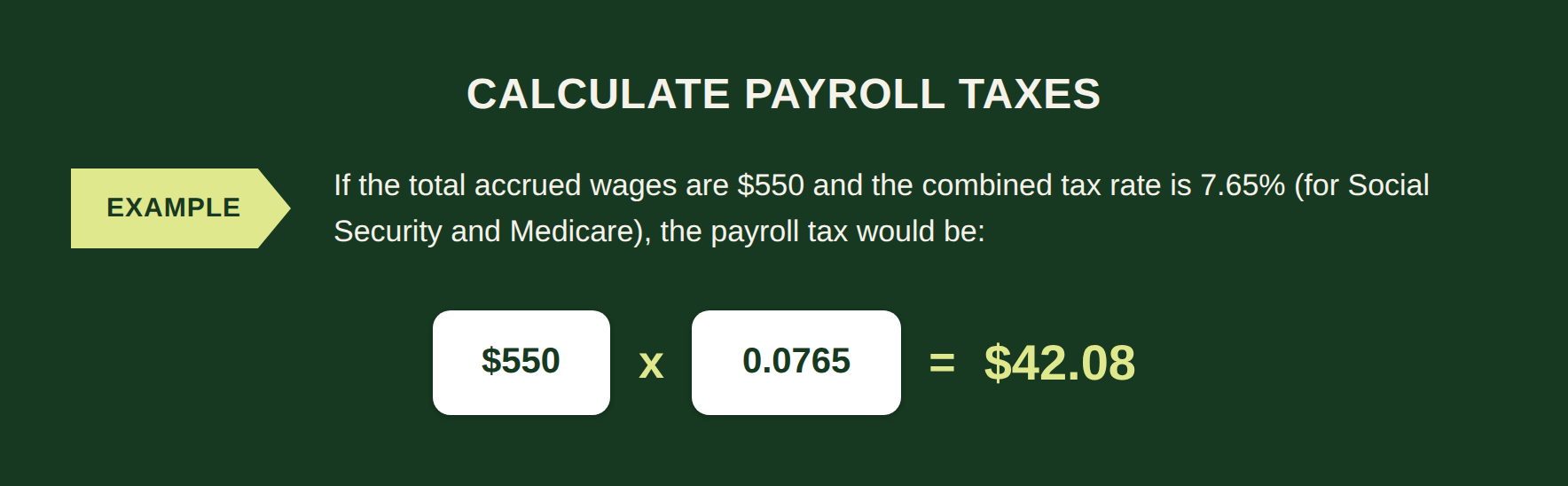
Add up all the calculated amounts for wages, overtime, additional pay elements, and payroll taxes to get the total accrued payroll.

Of course, there’s an easier way to ensure your accounting books are accurate and you maintain compliance with accounting standards, it is called payroll software.
An on-demand payroll software solution is automated ad integrates with your HR and timesheet data. This simplifies payroll tax filing and processing – all of which mitigate human errors and ensure payroll accuracy.
Even better, you’ll save ample time so you can focus on other top priorities. Just take it from Jeff Berliner, Chief Information Officer at the Institute for Advanced Study, who reflects on his organization’s switch to payroll software, “The solution’s automation functionality means that activities like payroll processing and validation that used to take us 15 or 20 hours per week can now be done in a matter of minutes.”
As mentioned, payroll accrual offers several advantages that help businesses maintain accurate financial records and improve cash flow management.
Some key benefits are:
By now, you should hopefully see that payroll accrual is a strategic tool that helps enhance your company’s overall financial management. Knowing the exact numbers—what’s coming in, going out, and when—contributes to improved economic health and operational efficiency for your organization.
With this information top-of-mind, accrued wages, taxes, and PTO become second nature in your financial analysis, improving accuracy as you plan budgets, headcount, and other positive changes for the future.



.jpg)
%201.png)